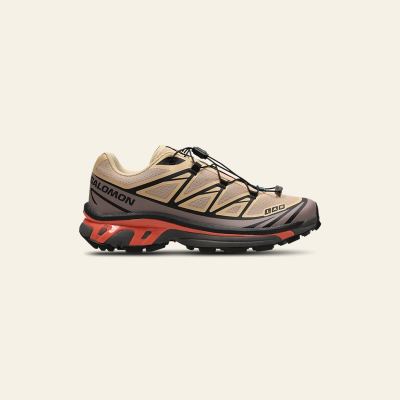
Salomon and HOKA solve the same problem — cushioning and grip for off-road running — with almost opposite designs. Salomon builds around a low-to-the-ground, structural chassis: a narrower, precise fit, an aggressive Contagrip outsole, and a stack height around 30mm that keeps you connected to the terrain, which makes it the sharper choice on technical, muddy, or steep singletrack under about 15 miles. HOKA takes the opposite approach, stacking maximum foam (often 33mm or more) under a wider platform and a rocking sole geometry that favors sustained cushioning over ground feel, which is why it tends to win out for long days on your feet, wider or bunion-prone feet, and ultramarathon-distance efforts. Neither shoe is simply “better” — the right pick depends on the terrain and distance you actually run.

Key Takeaways
- Salomon fits narrower through the toe box; HOKA runs medium-to-wide, with dedicated Wide sizing on models like the Speedgoat.
- Salomon’s stack sits around 30mm heel / 20mm forefoot (10mm drop); HOKA’s Speedgoat runs about 33mm / 29mm (4mm drop) — noticeably more foam, less drop.
- Salomon’s Contagrip outsole excels on mud, steep, and technical terrain; HOKA’s Vibram Megagrip outsole holds better on wet rock and roots.
- Both brands sit in a similar weight class (roughly 9.5–10.5 oz in a men’s US 10.5) and similar price band (around $145–$160).
- Expect 300–500 miles of life from either shoe before the lugs noticeably degrade, depending on terrain abrasiveness.
Salomon vs HOKA at a Glance
| Feature | Salomon (e.g. Speedcross / XA Pro) | HOKA (e.g. Speedgoat) |
|---|---|---|
| Fit | Narrower, precise, structural chassis | Medium-wide, roomier forefoot, Wide option available |
| Stack height | ~30mm heel / 20mm forefoot | ~33mm heel / 29mm forefoot |
| Drop | ~10mm | ~4mm |
| Outsole | Contagrip — deep chevron lugs | Vibram Megagrip — 5mm lugs |
| Best for | Technical, muddy, steep terrain under ~15 miles | Long distances, ultras, wider or fatigued feet |
| Typical price | ~$145–$160 | ~$155–$160 |
Why the Fit and Feel Are So Different
Salomon’s design philosophy centers on what the brand calls chassis rigidity — a structured, torsionally stiff platform (the 3D Advanced Chassis on models like the XA Pro) that locks your foot in place for lateral stability on off-camber slopes and rocky scrambles. That precision comes at the cost of room: reviewers consistently describe the toe box as narrow, and a shoe like the Speedcross can start to feel tight on runs past 15 miles as feet naturally swell.
HOKA’s philosophy is almost the inverse — protective volume instead of structural precision. Maximum foam depth and an extended rocker geometry absorb impact over long efforts and smooth out your stride, at the cost of some of the direct ground feel that makes Salomon confidence-inspiring on technical descents. The lower 4mm drop on the Speedgoat, compared to Salomon’s roughly 10mm, also changes how the foot loads through a stride, which is part of why some runners need a short adjustment period switching between the two brands.
The Nuance: Grip and Durability Trade Off Differently
It’s tempting to call one outsole simply “better,” but the comparison depends on conditions. Vibram Megagrip is widely regarded as the stronger compound on wet granite, polished roots, and rain-soaked, compact soil — exactly the conditions where a missed step is costly. Contagrip, meanwhile, is described by reviewers as fully adequate for recreational, drier trail conditions without matching Megagrip’s wet-surface performance, but it tends to hold up better against abrasion on rocky terrain, where Megagrip can wear faster despite its superior traction. In other words, the grippier compound in the wet isn’t necessarily the longer-lasting one on sharp rock — durability and grip pull in different directions depending on where you actually run.
Our Recommendation
If most of your runs are shorter, technical, and steep — think off-camber alpine trails or muddy, rooty singletrack — Salomon’s lower stack and structured chassis will likely feel more stable and confidence-inspiring underfoot. If you’re training for or racing an ultramarathon, spend long hours on your feet, or have wider or bunion-prone feet, HOKA’s extra cushioning and roomier platform is the more forgiving choice over distance. Runners who do a mix of both terrains and distances often end up owning one of each rather than picking a single “winner.”
Frequently Asked Questions
Is Salomon or HOKA better for trail running?
Neither is universally better — Salomon suits shorter, technical, steep terrain, while HOKA suits long-distance comfort and wider feet. The right choice depends on your typical run.
Does Salomon run narrow?
Yes, most Salomon trail models, including the Speedcross, have a narrower toe box than HOKA’s equivalents. Runners with wide feet often find them tight on longer efforts.
Does HOKA come in wide sizes?
Yes, several HOKA trail models, including the Speedgoat, are available in a Wide fit option, in addition to their already roomier standard forefoot.
Which brand has better grip in wet conditions?
HOKA’s Vibram Megagrip outsole is generally rated stronger on wet rock, roots, and rain-soaked soil. Salomon’s Contagrip is adequate for typical recreational trail conditions but isn’t matched to the same wet-surface performance.
How many miles do trail shoes from either brand last?
Most reviewers report 300–500 miles before meaningful lug degradation on both brands, though the exact figure depends heavily on how abrasive and rocky your usual terrain is.
If you lean toward the Salomon side of this comparison, our Salomon sizing guide covers how their trail shoes fit compared to typical road running sneakers.
Considering a pair for yourself? Browse Cecile Milan’s Salomon collection or the HOKA lineup to compare current stock and colorways.
Comments
One response to “Salomon vs HOKA: Which Trail Running Shoe Should You Buy?”
[…] deciding on a brand? Our Salomon vs HOKA comparison looks at how the two trail-running favorites stack up beyond just […]