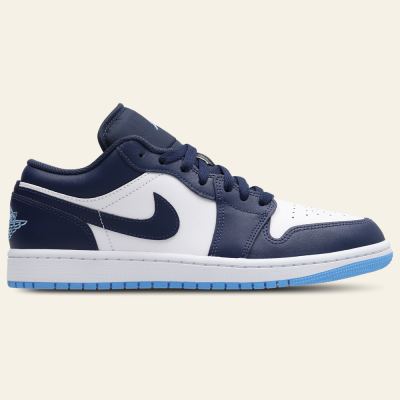
Few names in sneaker culture carry as much weight as Air Jordan, and two silhouettes come up in almost every conversation about which pair to buy first: the Air Jordan 1 and the Air Jordan 4. Both are directly tied to Michael Jordan’s own career, both are reissued constantly in new colorways, and both routinely top every “grail” list — but they solve different problems. Here’s how they actually compare.

Quick Comparison: Air Jordan 1 vs Air Jordan 4
| FEATURE | AIR JORDAN 1 | AIR JORDAN 4 |
|---|---|---|
| Released | 1985 | 1989 |
| Designer | Peter Moore | Tinker Hatfield |
| Collar | High-top | Mid-top |
| Best for | Everyday looks | Streetwear |
Air Jordan 1: The Original Icon
Released in 1985 and designed by Peter Moore, the Air Jordan 1 became famous before it ever touched a basketball court — the NBA fined Michael Jordan for wearing the “Banned” colorway, and the controversy turned the shoe into a cultural phenomenon overnight. It’s built around a full-leather upper, a high-top collar, and simple, bold color-blocking that has barely changed in four decades.
Strengths:
- Full-leather construction that’s genuinely durable and ages well
- The single most recognizable silhouette in sneaker history, available in High, Mid and Low cuts
- The widest colorway range of any Jordan model, from quiet neutrals to statement pairs
Best paired with: straight-leg jeans, chinos or shorts — the Jordan 1 is arguably the easiest “grail” sneaker to wear with an everyday outfit.
Air Jordan 4: Performance Meets Design
The Jordan 4 arrived in 1989, designed by Tinker Hatfield, and became inseparable from Michael Jordan’s career after “The Shot” — his buzzer-beater over Craig Ehlo in the 1989 playoffs, hit while wearing this exact model. It takes a more technical approach than the Jordan 1: a mid-top collar, a visible Nike Air unit in the midsole, mesh panels for breathability, and the distinctive wings eyelets and lace locks that make it instantly identifiable.
Strengths:
- Visible Air-Sole cushioning built for genuine impact absorption
- Mid-top collar that trades some ankle coverage for more freedom of movement
- A more technical, “engineered” look that pairs well with both streetwear and smart-casual pieces
Best paired with: cargo pants, joggers or tapered denim — the Jordan 4’s chunkier profile wants a bit of volume to balance it.
Comfort and Fit
Both models use Nike Air cushioning, but the ride differs. The Jordan 4’s mid-top collar and mesh paneling make it noticeably more flexible for all-day wear, while the Jordan 1’s higher, stiffer leather collar takes longer to break in but offers more ankle structure. One detail worth knowing before you buy: Nike updated the Air Jordan 4’s last in 2023, giving the current version a more generous, rounder fit than pairs made before that update — something to factor in if you’re comparing a brand-new pair to an older one on the resale market.
Sizing: How Do They Fit?
Jordan footwear generally follows Nike’s standard length sizing, but width and break-in time vary by model. As a rule of thumb, the Air Jordan 1 runs true to size in length, with wide-footed buyers often sizing up half a size. The Air Jordan 4 also runs true to size on the current (2023-onward) last, though pre-2023 pairs fit slightly snugger and may justify sizing up half a size for wide feet.
| US | EU | UK | Foot Length (cm) |
|---|---|---|---|
| 7 | 40 | 6 | 25 |
| 8 | 41 | 7 | 26 |
| 9 | 42.5 | 8 | 27 |
| 10 | 44 | 9 | 28 |
| 11 | 45 | 10 | 29 |
| 12 | 46 | 11 | 30 |
| 13 | 47.5 | 12 | 31 |
For a full breakdown of every size in between, see our Jordan sizing guide.
Versatility
If your wardrobe leans toward simple, everyday pieces, the Jordan 1 will get more consistent wear — it’s the shoe equivalent of a white t-shirt, working with almost anything. If you already dress in a more technical or streetwear-forward way, with cargo pieces and layering, the Jordan 4 integrates more naturally and reads as slightly more “collector.”
The Verdict
There’s no wrong choice here — these are arguably the two most important Jordan silhouettes ever released, each for different reasons. If you want one durable, endlessly versatile pair that anchors almost any outfit, go Jordan 1. If you want a more technical, performance-driven design with genuine basketball history behind it, go Jordan 4. Many collectors treat this less as a choice and more as a starting checklist, since the two barely compete for the same outfit.
Frequently Asked Questions
Do Air Jordan 1s run true to size?
Yes. The Air Jordan 1 generally runs true to size in length. If you have wider feet, consider sizing up half a size for extra room across the widest part of the foot.
Is the Air Jordan 4 true to size?
The current Air Jordan 4, updated in 2023, runs true to size with a slightly more generous fit than earlier versions. Pairs made before 2023 fit a little snugger, so sizing up half a size is worth considering for wide feet or thicker socks.
Which Jordan is better for basketball, the 1 or the 4?
The Jordan 4 is the more performance-oriented design, with a visible Air-Sole unit and a mid-top collar built for freedom of movement on court. The Jordan 1’s higher collar and stiffer leather make it better suited to everyday wear than active play.
Are the Air Jordan 1 and Air Jordan 4 good for wide feet?
Both can work for wider feet, but expect to size up about half a size in either model. The Jordan 4’s mesh paneling also gives it slightly more natural stretch than the Jordan 1’s all-leather upper.
Which Jordan holds its resale value better, the 1 or the 4?
Both models hold value well thanks to their historical significance, though limited Jordan 4 colorways tend to command higher premiums due to lower general production numbers compared to the more widely produced Jordan 1.
Shop the Models in This Comparison
Shop the Air Jordan 1 lineup — plus the full Nike and Jordan range — at Cecile Milan.