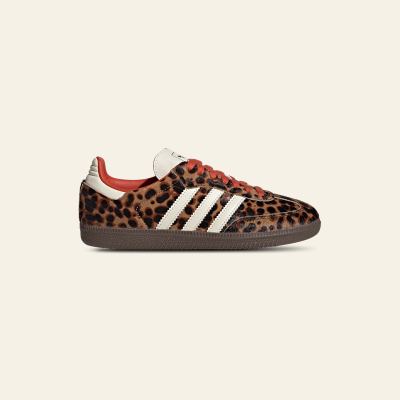

The Adidas Samba was originally designed around 1949-1950 by Adolf Dassler as a training shoe for football players to use on frozen or hard ground, where traditional studded boots offered poor traction. Its defining feature is a gum rubber outsole with a suction-cup-style tread pattern that grips smooth, hard surfaces, paired with a low-cut leather or suede upper that allowed close ball control. The shoe saw a wider commercial release in 1972 with an updated three-zone outsole for multidirectional grip, which is the version closest to what’s sold today. Decades later, the Samba’s low profile, gold foldover tongue with the trefoil logo, and classic three-stripe design have made it a recurring streetwear and fashion staple, cycling in and out of popularity roughly every decade since the 1980s.
Key Takeaways
- The Samba was designed around 1949-1950 by Adolf Dassler specifically for football training on icy or hard ground.
- Its gum rubber sole uses a suction-pattern tread designed to grip smooth surfaces rather than turf.
- A wider commercial release followed in 1972 with an updated three-zone sole for multidirectional traction.
- The low-cut leather/suede upper and gold foldable tongue with the trefoil logo are the shoe’s signature identifying features.
- The Samba has resurfaced as a fashion staple multiple times since the 1980s, most recently as a dominant “quiet luxury” and streetwear shoe.
Quick Reference
| Attribute | Detail |
|---|---|
| Original design era | ~1949-1950, by Adolf Dassler |
| Original purpose | Football training on icy/hard ground |
| Wider commercial release | 1972, with updated 3-zone outsole |
| Sole material | Gum rubber with suction-cup-style tread |
| Upper material | Leather or suede, low-cut silhouette |
| Signature details | Gold foldover tongue with trefoil, three stripes |
| Best known today for | Streetwear/lifestyle staple, minimalist everyday sneaker |
Where the Samba Actually Came From
Direct Answer: the Samba began life as a functional football training shoe, not a fashion sneaker — its now-iconic look grew out of a very specific performance problem.
Explanation: in the late 1940s, football players training in winter faced a real problem: metal or rubber studs common on match boots offered little grip on frozen or icy pitches, and could even be dangerous. Adolf Dassler’s solution was a gum rubber sole molded with a suction-cup-like pattern that created grip through surface contact rather than studs digging into turf, paired with a snug, low leather upper that kept close touch and feel for ball control.
Nuance: some sources place the original design closer to 1949 and others to 1950, and the shoe’s wider commercial availability didn’t happen until the 1972 relaunch with an updated three-zone outsole, so “designed in the late 1940s, popularized commercially in 1972” is the most accurate framing rather than a single clean date.
Recommendation: when you see references to different Samba “origin years,” treat 1949/1950 as the design/prototype period and 1972 as the point the shoe most resembles today’s retail version.
Fit and How to Wear It Today
Direct Answer: the Samba has a low-cut, fairly snug silhouette that generally runs true to size but suits a slightly narrower foot best.
Explanation: because the shoe was built for close foot-to-ball feel rather than cushioned comfort, its leather/suede upper sits close to the foot with minimal padding, and the flat, thin sole means little to no arch support or shock absorption compared to a modern running shoe. This makes it comfortable for short-to-moderate wear and casual styling, but not ideal as an all-day walking or standing shoe for everyone.
Nuance: wide-footed wearers sometimes find the toe box narrower than expected and may want to size up half a size, while narrow-footed wearers usually find the fit accurate to true size.
Recommendation: style the Samba the way it has become known in recent years — with straight or slightly wide-leg trousers, jeans, or shorts that let the low-cut silhouette and gold tongue detail show, rather than covering the shoe entirely.
Frequently Asked Questions
Is the Adidas Samba a football shoe or a lifestyle shoe today?
Both, in different eras. It was originally a functional football training shoe, but the version sold today is marketed and worn almost exclusively as a lifestyle and streetwear sneaker.
How is the Samba different from the Adidas Gazelle?
Both share three-stripe branding and a low-cut silhouette, but the Samba has a distinctive gum rubber sole with a suction-pattern tread and a slightly more pointed toe shape, while the Gazelle typically has a rounder toe and a simpler flat rubber sole originally designed for indoor training rather than icy outdoor pitches.
Does the Samba run true to size?
Generally yes for most wearers, though the toe box can feel narrow for wide feet, in which case sizing up half a size is a common adjustment.
Are Sambas good for all-day wear?
They’re comfortable for casual, moderate use, but the flat sole and minimal cushioning mean they offer less all-day support than a dedicated lifestyle or walking sneaker.
What materials are Sambas typically made from?
Most versions use a leather or suede upper on a gum rubber outsole, though colorways and material combinations vary by release.
Why has the Samba become so popular again recently?
Like many heritage sneakers, the Samba has cycled in and out of mainstream fashion roughly every decade since the 1980s; its low-profile, minimalist silhouette has made it a natural fit for recent “quiet luxury” and understated streetwear trends.
Trying to decide between the Samba and its closest sibling? Read our Adidas Samba vs Gazelle comparison for a full breakdown.
Shop the current Samba lineup in the Adidas Samba men’s and Adidas Samba women’s categories on cecilemilan.com.